
St. Thomas Aquinas
The Angelic Doctor
His family locked him in a tower for a year to break his vocation. He would not be broken — and became the greatest teacher the Church has ever produced.
- Feast
- January 28
- Lived
- 1225–1274
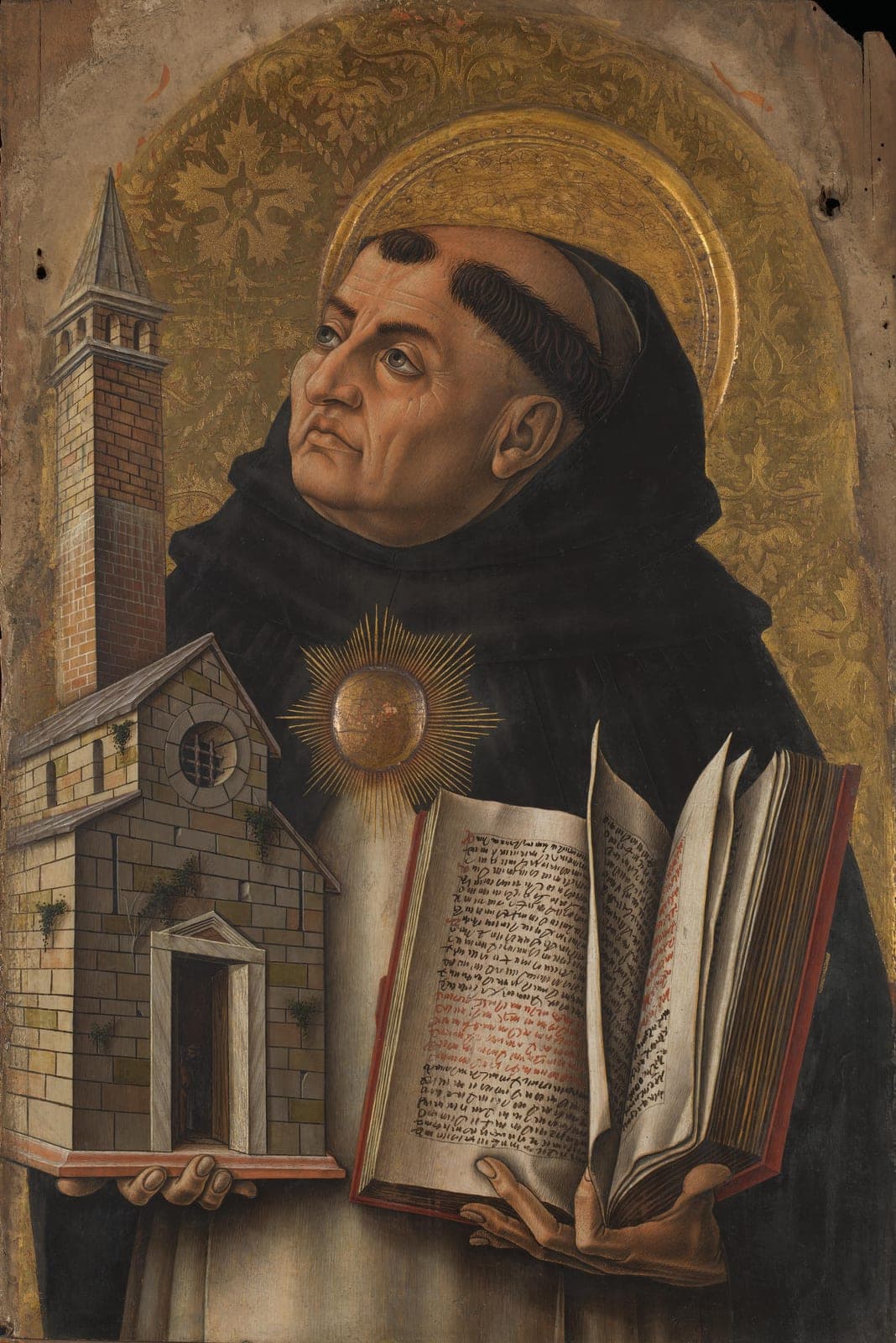
Invoked For
- Students
- Schools and universities
- Theologians
- Booksellers
His Life
Thomas was born in 1225 in his family's castle at Roccasecca, between Rome and Naples, the son of minor nobility with grand plans for him: he was to be abbot of the great and wealthy monastery of Monte Cassino. Instead, at nineteen, he announced he was joining the Dominicans — a new order of begging preachers, which to his family was roughly like announcing he intended to be poor for life.
His brothers kidnapped him on the road and imprisoned him in the family tower for over a year. They tried everything to break his resolve — finally sending a woman to seduce him, whom Thomas drove from the room with a burning brand snatched from the fire. His family gave up. He walked out of the tower still a Dominican.
In the schools of Paris and Cologne, his classmates called the big, silent southerner "the dumb ox." His teacher, St. Albert the Great, heard him dispute once and made the most famous prophecy in academic history: "You call him a dumb ox, but the bellowing of that ox will fill the whole world." It did. In twenty years of ceaseless work Thomas produced the Summa Theologiae and a shelf of works that ordered the whole of Christian thought — always with a startling humility, checking every argument against Scripture, the Fathers, and plain reason.
Near the end of his life, while celebrating Mass in December 1273, something happened that he would never fully describe. He stopped writing entirely. When his secretary begged him to continue the Summa, he answered: "I cannot. All that I have written seems to me like straw compared with what has now been revealed to me." He died three months later, on the road to a Church council, not yet fifty.
The Path to Sainthood
Thomas was canonized in 1323 by Pope John XXII. When the examiners noted a shortage of spectacular miracles, the pope is said to have answered that every article of the Summa was a miracle — an exaggeration with a point, since the Church has treated his work as near-normative ever since.
He was declared a Doctor of the Church — the Angelic Doctor — in 1567, and successive popes have named his method the model for Catholic theology and philosophy. The hymns he wrote for the feast of Corpus Christi, including the Tantum Ergo and O Salutaris, are still sung at Benediction in every country on earth.
At the canonization inquiry, a witness summed up his secret: asked in a vision what reward he would have for his writing, Thomas had answered, "Nothing but Thyself, Lord."
Prayers to St. Thomas Aquinas
Tap any prayer to open it large and clear — set for reading aloud. Close it to return here and choose another.