
St. Teresa of Ávila
Doctor of Prayer
A witty, worldly Spanish nun who at nearly forty finally surrendered to God — then reformed an entire religious order and taught the whole Church how to pray.
- Feast
- October 15
- Lived
- 1515–1582
Invoked For
- Spain
- Those in need of grace
- People ridiculed for their piety
- Headache sufferers
His Life
Teresa de Ahumada was born at Ávila in Castile in 1515. At seven she persuaded her little brother to run away with her to be martyred by the Moors — an uncle caught them outside the city walls. The child who wanted heaven cheaply grew into a charming, clever young woman who entered the Carmelite convent at twenty and then spent nearly two decades as a thoroughly mediocre nun, by her own cheerful admission: the convent parlor was a social hub, and she was its star.
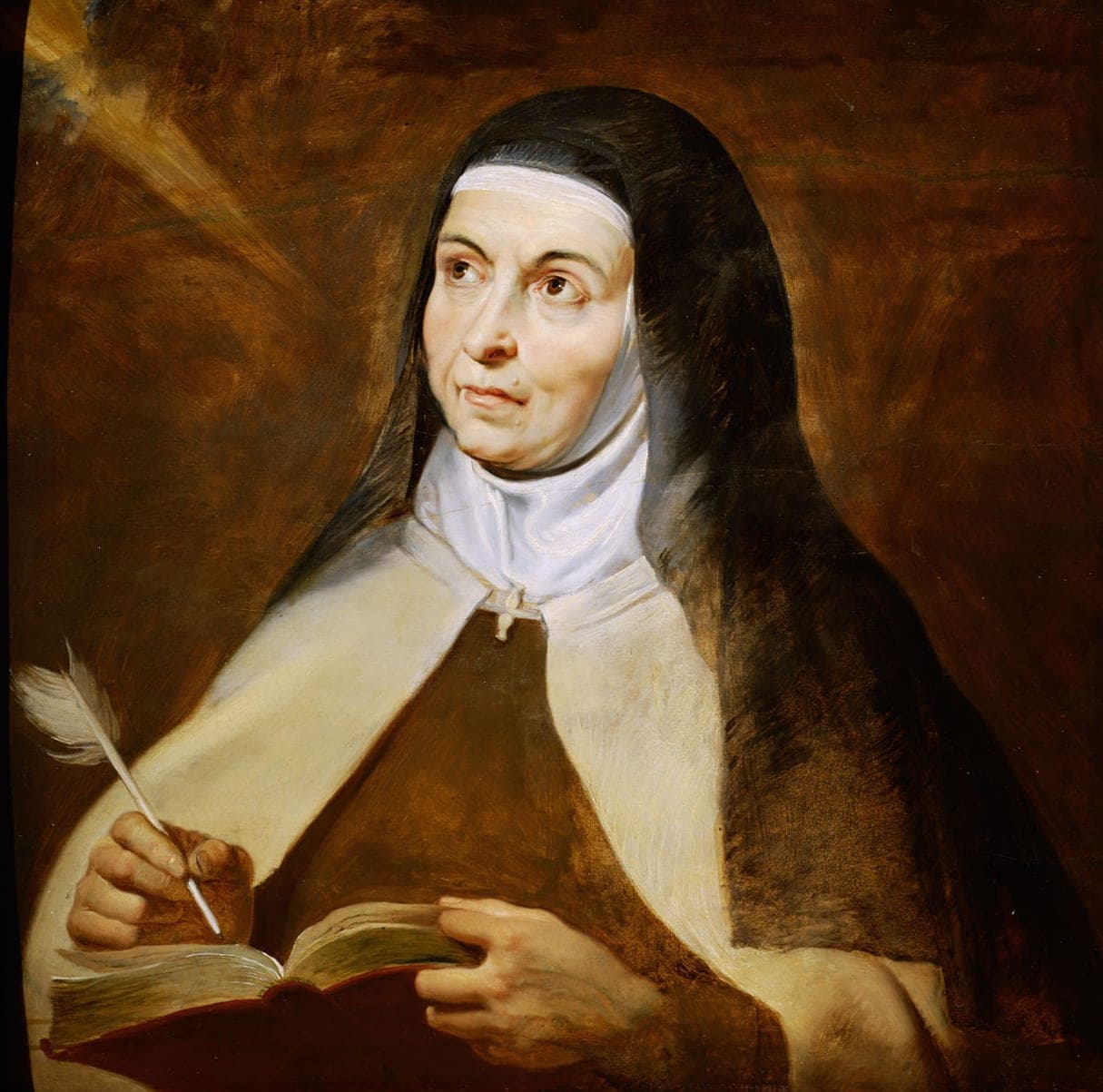
The turning point came at thirty-nine, when she was stopped cold before an image of the wounded Christ. "I felt how badly I had thanked Him for those wounds," she wrote. From then on her life of prayer deepened into experiences she described with a precision no writer had matched — culminating in the vision of an angel piercing her heart with a golden dart, leaving her "on fire with a great love of God."
But Teresa's mysticism made her more practical, not less. Convinced her order had grown soft, she founded a reformed convent of strict observance at Ávila in 1562 — against the fury of the town, her own order, and nearly everyone she knew. She spent the last twenty years of her life on the terrible roads of Spain, founding seventeen reformed Carmels, negotiating with bishops and buying houses, all while chronically ill. Her humor never failed: thrown from a cart into a river, she complained to the Lord and heard, "This is how I treat my friends." "Then, Lord," she answered, "it is no wonder You have so few."
She wrote her great books — her Life, The Way of Perfection, The Interior Castle — under obedience, at night, after the day's work. She died at Alba de Tormes in 1582, saying, "At last I die a daughter of the Church."
The Path to Sainthood
Teresa was canonized in 1622 by Pope Gregory XV, in the same ceremony as St. Ignatius of Loyola and St. Francis Xavier — a single day that gave the Church three of its giants.
In 1970 Pope Paul VI declared her a Doctor of the Church, the first woman ever so named. Her analysis of the soul's journey to God in The Interior Castle remains the standard map of Christian prayer four and a half centuries later.
Her reform survives as the Discalced Carmelites, the order that later gave the Church St. Thérèse of Lisieux and St. Edith Stein — both of whom called Teresa their mother in the life of prayer.
Prayers to St. Teresa of Ávila
Tap any prayer to open it large and clear — set for reading aloud. Close it to return here and choose another.