
St. John Paul II
Pope of the Rosary
He lost his whole family by twenty-one, worked under the Nazis, resisted the Communists, survived an assassin's bullets — and gave the Rosary its first new mysteries in centuries.
- Feast
- October 22
- Lived
- 1920–2005
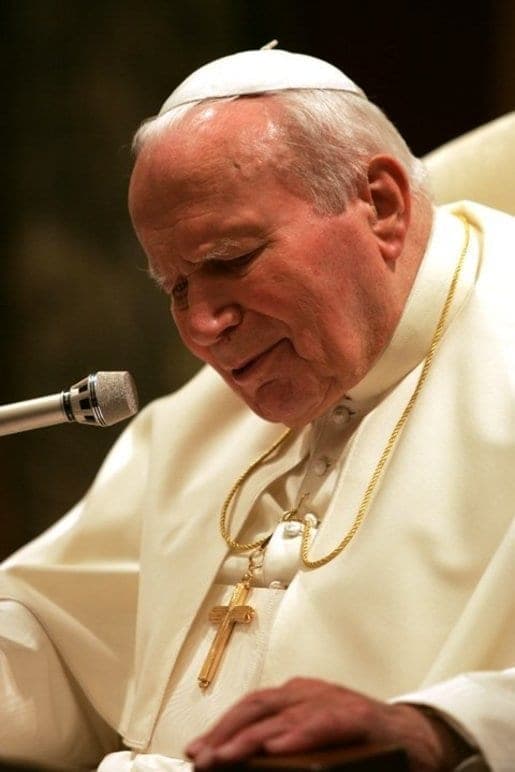
Invoked For
- World Youth Day
- Families
- Young people
- Poland
His Life
Karol Wojtyła was born in Wadowice, Poland, in 1920. Sorrow found him early: his mother died when he was eight, his only brother — a young doctor — at twelve, and his father, the retired officer who had taught him to pray, when Karol was twenty. He knelt all night by his father's body. By twenty-one, everyone he loved most was gone.
He came of age under the Nazi occupation, working in a stone quarry and a chemical plant by day while studying for the priesthood in the Archbishop of Kraków's clandestine seminary by night — discovery meant deportation or death. Ordained in 1946, he served as priest and then bishop under a new tyranny, the Communist state, which he opposed not with politics but with an immovable insistence on the dignity of the human person. The workers' town of Nowa Huta was built without a church on purpose; Wojtyła celebrated Mass in an open field there, in the snow, year after year, until the state gave in.
Elected pope in 1978 — the first non-Italian in 455 years — he took the motto Totus Tuus, 'totally yours,' addressed to Mary. His first words to the world were the theme of his whole pontificate: "Be not afraid!" His 1979 pilgrimage to Poland lit the fuse of the Solidarity movement; a decade later, the Communist bloc fell without a shot. On May 13, 1981 — the feast of Our Lady of Fátima — he was shot at close range in St. Peter's Square, and lived; he credited the Virgin's hand deflecting the bullet, which was later set into the crown of her statue at Fátima. Two years later he sat in a prison cell holding the hand of the man who shot him, and forgave him.
For this website his most personal gift came in 2002, when he wrote Rosarium Virginis Mariae and added the five Luminous Mysteries — the Baptism, Cana, the Kingdom, the Transfiguration, the Eucharist — the first change to the Rosary's mysteries in four and a half centuries. "The Rosary is my favorite prayer," he said simply. He prayed all twenty mysteries daily. His long public dying from Parkinson's disease, hiding nothing, was his last teaching: that human life is worth living to its natural end. He died on April 2, 2005, as the crowds in the square below prayed the Rosary.
The Path to Sainthood
At his funeral, the largest in history, the crowds chanted 'Santo subito!' — sainthood now! The Church moved with unusual speed while still observing every step: Pope Benedict XVI waived the customary five-year waiting period, and the cause opened weeks after his death.
The healing of a French nun, Sister Marie Simon-Pierre, from Parkinson's disease — the same illness that had killed him — was accepted for his beatification in 2011. A second inexplicable cure, of a Costa Rican woman with a brain aneurysm on the very day of that beatification, led to his canonization by Pope Francis on April 27, 2014, Divine Mercy Sunday, with his predecessor Benedict XVI concelebrating.
His feast is October 22, the anniversary of the inauguration of his papacy. He is buried beneath the altar of St. Sebastian in St. Peter's Basilica, a few steps from Peter himself.
Prayers to St. John Paul II
Tap any prayer to open it large and clear — set for reading aloud. Close it to return here and choose another.