
St. Catherine of Siena
Doctor of the Church
The twenty-fourth child of a Sienese dyer, who could not read as a girl — yet lectured popes, carried the wounds of Christ, and talked the papacy itself back to Rome.
- Feast
- April 29
- Lived
- 1347–1380
Invoked For
- Italy
- Europe
- Nurses
- Against fire
- Those ridiculed for their faith
His Life
Catherine Benincasa was born in Siena in 1347, the twenty-fourth of twenty-five children of a wool dyer. At six she saw a vision of Christ in glory above the church of San Domenico, and at seven she privately vowed herself to God. When her parents pressed her to marry, she cut off her hair; when they punished her by making her the household servant, she served so cheerfully that her father finally relented and gave her a room of her own for prayer.
She joined the Dominican tertiaries — laywomen in the world, not nuns — and after three years of solitude heard Christ send her out: to nurse the sick in the hospitals of Siena, including the plague victims and lepers no one else would touch. Around her gathered a famiglia of disciples, men and women, many of them her elders, who called this dyer's daughter 'Mamma.'
Then her life became public in a way no woman's of her century was. In an age when the popes had abandoned Rome for Avignon for seventy years, Catherine — who had learned to read only as an adult and dictated rather than wrote — sent letters to kings, queens, and to Pope Gregory XI himself, addressing him fearlessly as 'Babbo' (Daddy) and telling him plainly to be a man and return to Rome. In 1376 she went to Avignon in person. In 1377, the pope returned to Rome.
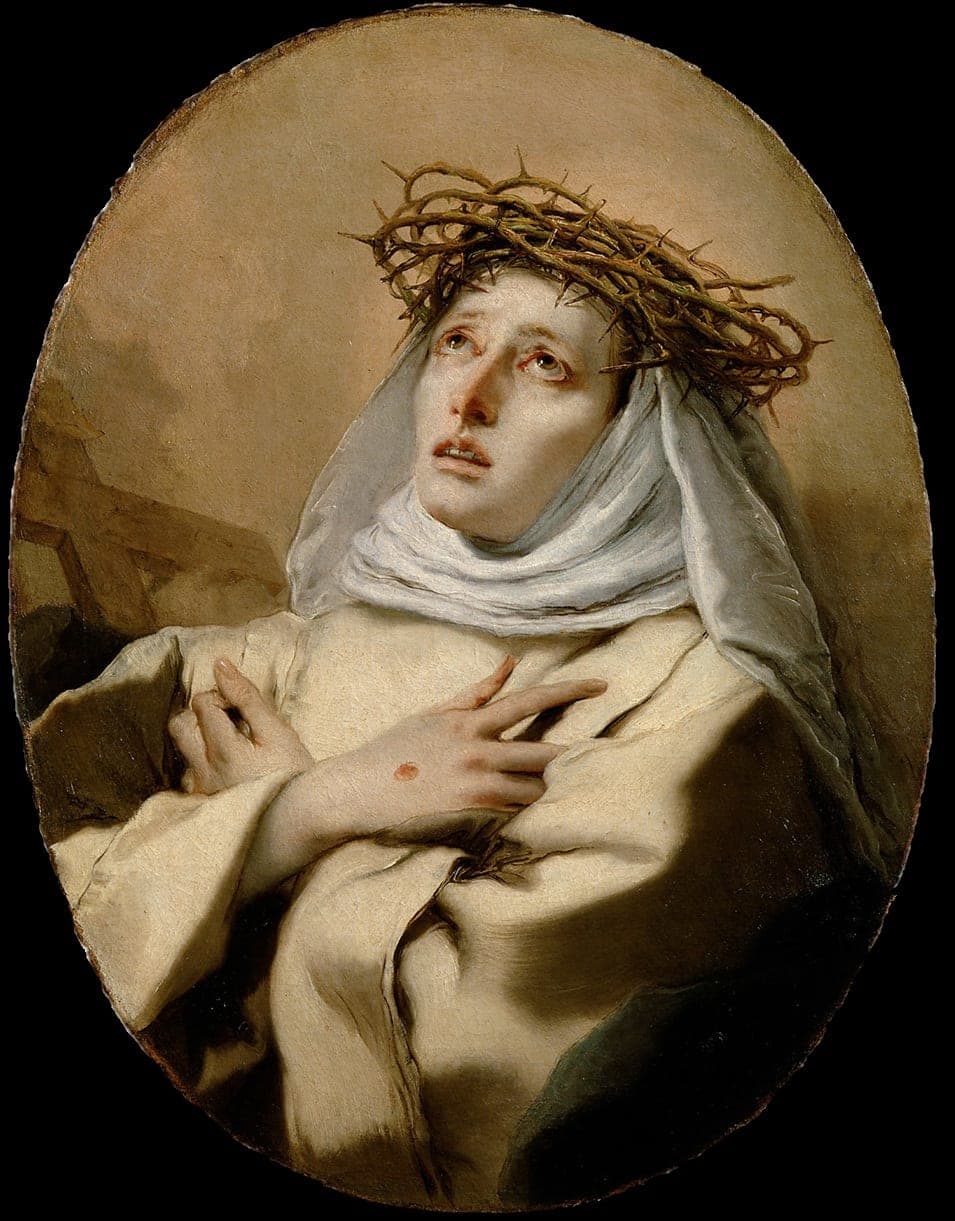
In 1375 she had received the stigmata — the wounds of Christ — though at her own prayer they remained invisible during her life. Her great book, the Dialogue of Divine Providence, was dictated in ecstasy. She wore herself out for the Church during the schism that followed Gregory's death, and died at Rome in 1380, aged thirty-three.
The Path to Sainthood
Catherine was canonized in 1461 by Pope Pius II, himself a Sienese, who performed the ceremony with particular joy for his city's daughter.
In 1970 Pope Paul VI declared her a Doctor of the Church — one of the first two women ever so named, alongside St. Teresa of Ávila. In 1999 John Paul II named her co-patroness of Europe. That a woman with no formal schooling holds the Church's highest teaching title is itself the lesson of her life: 'Be who God meant you to be,' she said, 'and you will set the world on fire.'
Her body rests beneath the high altar of Santa Maria sopra Minerva in Rome; her native Siena keeps her head in the church of San Domenico, where she first saw her visions.
Prayers to St. Catherine of Siena
Tap any prayer to open it large and clear — set for reading aloud. Close it to return here and choose another.