
St. Augustine of Hippo
Doctor of Grace
The brilliant, restless sinner whose mother prayed for him for seventeen years — and whose conversion gave the Church her greatest teacher after the apostles.
- Feast
- August 28
- Lived
- AD 354–430
Invoked For
- Theologians
- Printers
- Brewers
- Those with wayward children
His Life
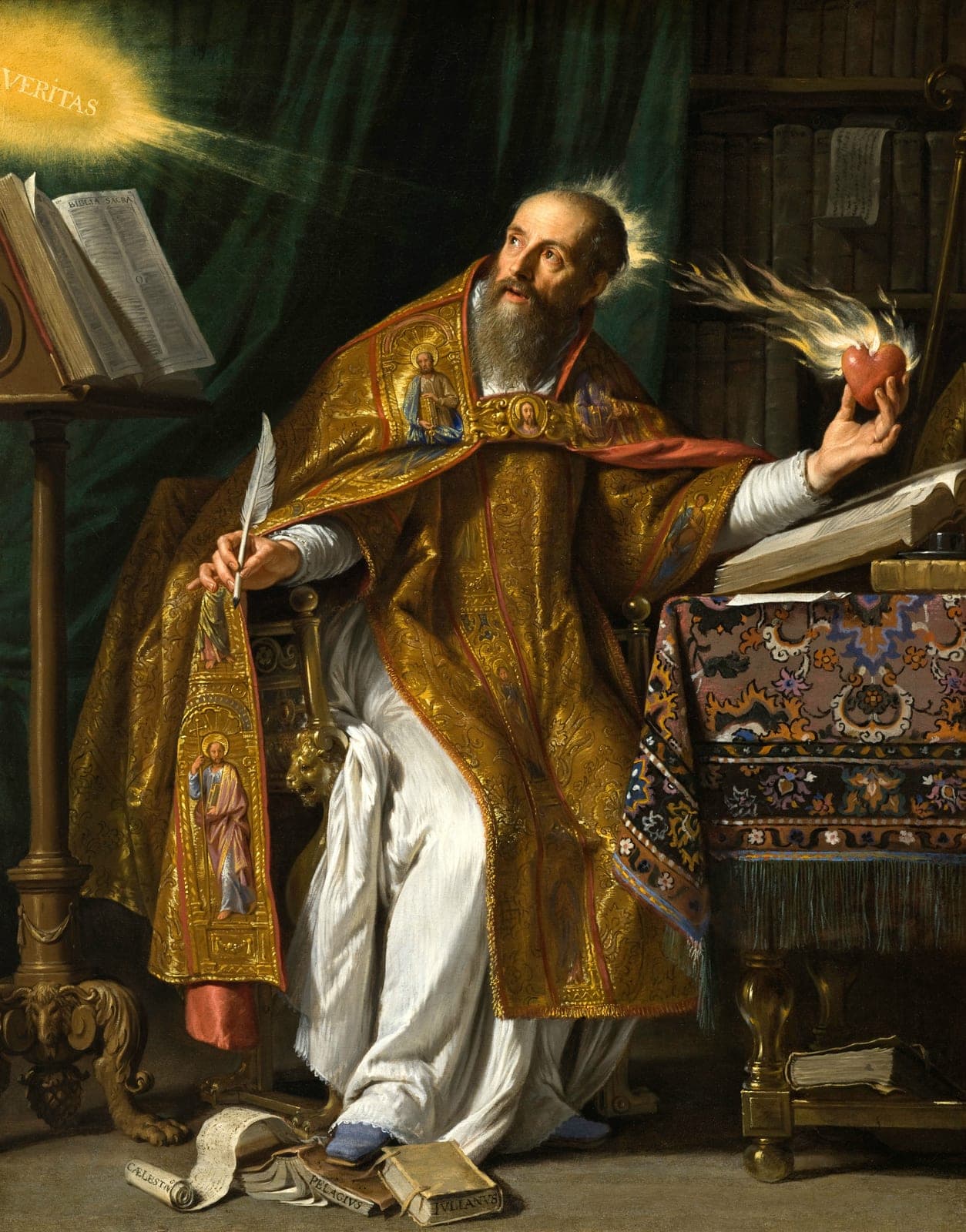
Augustine was born in 354 at Tagaste in Roman North Africa, to a pagan father and a Christian mother — Monica, who would become a saint herself by praying for him. He was dazzlingly gifted, and he knew it. He took a mistress at seventeen, fathered a son, chased every philosophy of his age, and spent years in the Manichean sect, all while his career as a teacher of rhetoric carried him from Carthage to Rome to Milan.
Monica followed him — literally, across the sea — weeping and praying for his soul for seventeen years. A bishop, wearied by her pleading, gave her the answer the Church has never forgotten: "It is not possible that the son of so many tears should perish."
In Milan, the preaching of St. Ambrose began to undo his objections, but Augustine found he could not give up his old life: "Lord, make me chaste — but not yet," he had prayed. The end came in a garden in the summer of 386, when in an agony of indecision he heard a child's voice chanting, "Take up and read." He opened the letters of St. Paul at random and read a single verse that finished the argument forever. "Late have I loved Thee," he would write, "O Beauty ever ancient, ever new — late have I loved Thee."
Baptized by Ambrose at Easter 387, he returned to Africa, was made bishop of the port city of Hippo, and for thirty-four years poured himself out — preaching daily, judging disputes, answering every heresy of the age, and writing the Confessions and The City of God, books that have never gone out of print in sixteen hundred years. He died in 430 with the Vandals besieging his city, the psalms of penance pinned to the wall where he could read them from his bed.
The Path to Sainthood
Augustine is a pre-congregation saint, venerated from the moment of his death by the acclamation of the whole Church. No formal process existed in 430, and none was needed: within a generation he was cited as an authority everywhere Christians wrote.
The Church named him a Doctor of the Church — the Doctor of Grace — among the first four so honored in 1298. More has been written about him than about any Christian thinker except his own subject, and both his conversion and his mother's persistence remain the Church's great proof that no one is beyond the reach of prayer.
His relics rest at Pavia in Italy, in the basilica of San Pietro in Ciel d'Oro, where they were carried for safekeeping in the eighth century.
Prayers to St. Augustine of Hippo
Tap any prayer to open it large and clear — set for reading aloud. Close it to return here and choose another.