
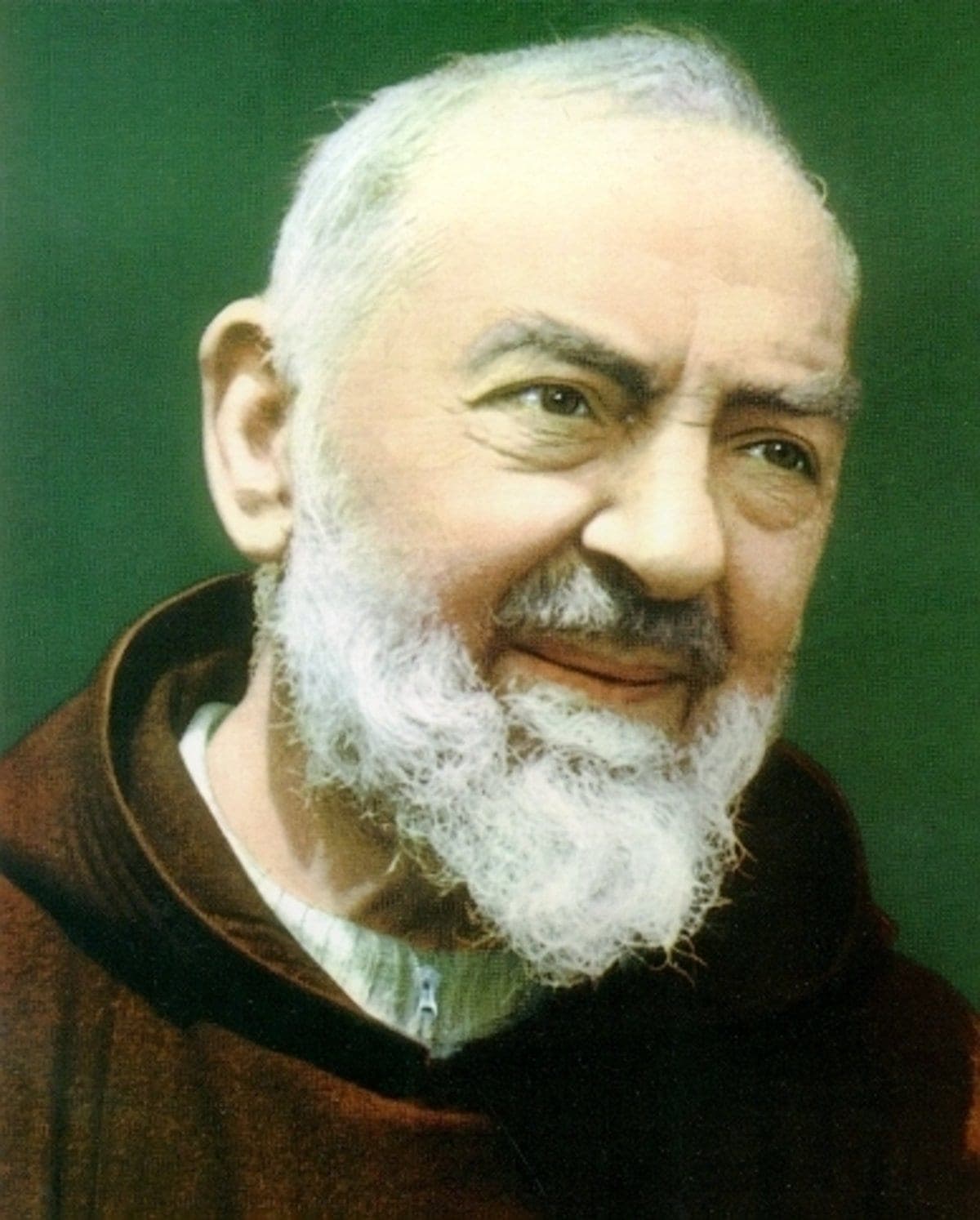
St. Pio of Pietrelcina (Padre Pio)
Bearer of the Wounds of Christ
A Capuchin friar who carried the visible wounds of Christ for fifty years, heard confessions twelve hours a day, and told an anxious world: pray, hope, and don't worry.
- Feast
- September 23
- Lived
- 1887–1968
Invoked For
- Civil defense volunteers
- Adolescents
- Stress relief
- The suffering
His Life
Francesco Forgione was born in 1887 to peasant farmers in Pietrelcina, in southern Italy. The boy was praying seriously by five, and at fifteen he entered the Capuchin friars, taking the name Pio. His health was so wretched — fevers no doctor could explain — that his superiors repeatedly sent him home to his village to die; he kept not dying, and was ordained a priest in 1910.
On September 20, 1918, while praying before a crucifix in the choir loft of the friary of San Giovanni Rotondo, Padre Pio received the stigmata — the five wounds of Christ, visible, painful, and bleeding. They remained for exactly fifty years, examined by doctors who could neither heal nor explain them, and they made the obscure friar famous against his every wish: "I only want to be a poor friar who prays."
What the pilgrims found when they came was not the wounds but the confessional. Padre Pio heard confessions ten and twelve hours a day, tens of thousands a year, with a startling gift for reading souls — penitents routinely reported that he reminded them of sins they had forgotten or concealed. His counsel became proverbial: "Pray, hope, and don't worry. Worry is useless. God is merciful and will hear your prayer." His days began at three in the morning with the Rosary, which he called his weapon, and centered on a Mass so intense it could last hours.
He suffered more than the wounds. For years in the 1920s and 30s, denounced by rivals, he was forbidden by the Vatican to say Mass publicly or hear confessions — and obeyed without one word of complaint, the obedience that later became a chief argument for his sanctity. Out of his suffering he built one of the great works of mercy of the century: the Casa Sollievo della Sofferenza, the 'Home for the Relief of Suffering,' a major hospital raised on a barren mountain by a friar vowed to poverty. He died on September 23, 1968, hours after the fiftieth anniversary of the stigmata; the wounds had closed without a scar.
The Path to Sainthood
The devotion of the millions who had knelt at his confessional did not wait for any decree, but the Church proceeded with her usual care: Pope John Paul II — who as a young priest had himself visited Padre Pio's confessional in 1947 — beatified him in 1999 and canonized him on June 16, 2002, before one of the largest crowds ever gathered in St. Peter's Square.
The miracles accepted for his cause included the medically inexplicable cure of a boy, Matteo Pio Colella, from meningitis with multiple organ failure — a case the doctors of his own hospital could not account for.
His shrine at San Giovanni Rotondo is now among the most visited in the world, and his prayer groups, which he founded in life, continue on every continent — small gatherings that do exactly what this website does: pray together.
Prayers to St. Pio of Pietrelcina (Padre Pio)
Tap any prayer to open it large and clear — set for reading aloud. Close it to return here and choose another.