
St. Teresa of Calcutta (Mother Teresa)
Saint of the Gutters
She left a comfortable convent to live among the dying in the slums of Calcutta — and carried on for fifty years through an interior darkness no one suspected until after her death.
- Feast
- September 5
- Lived
- 1910–1997
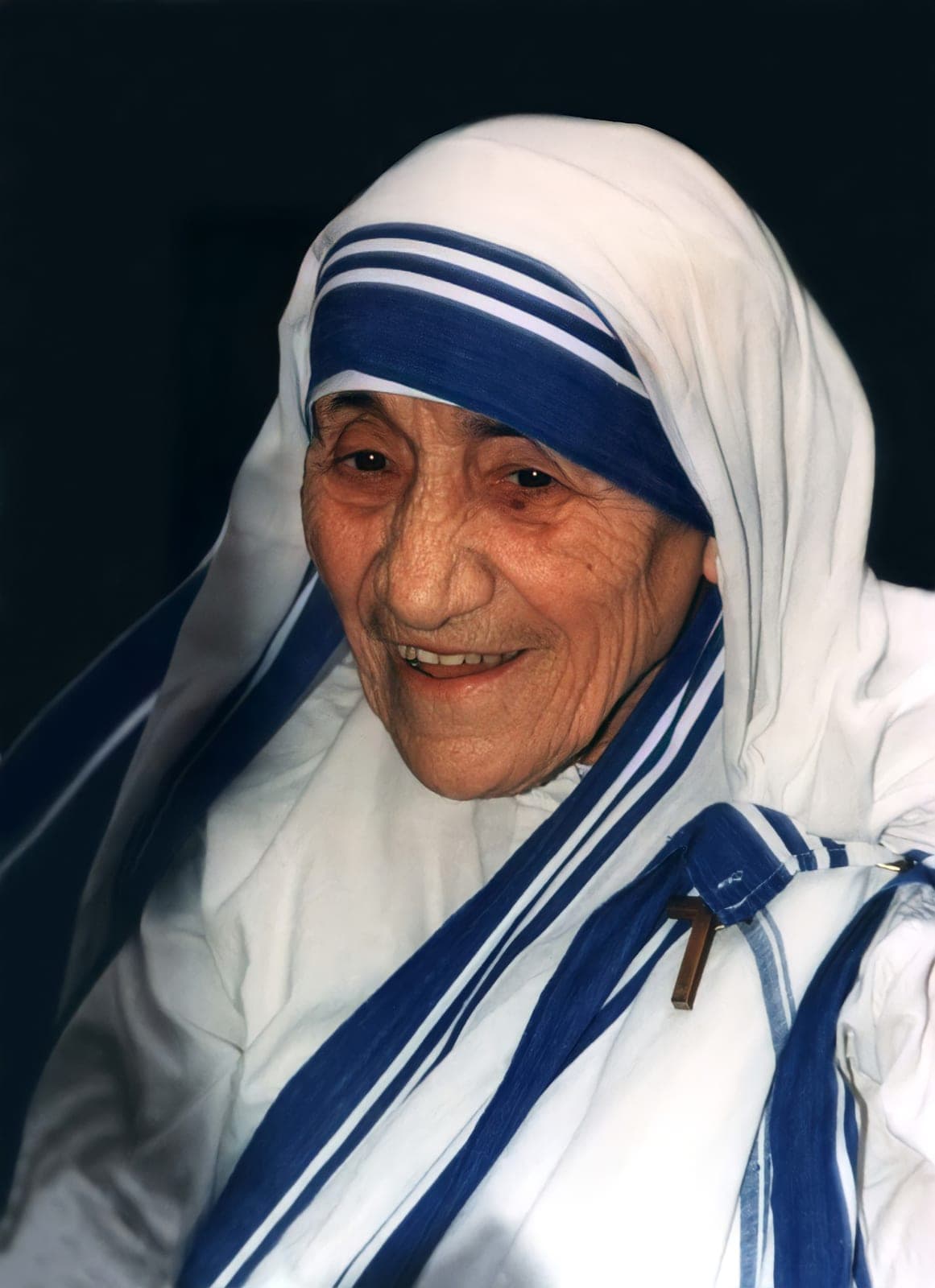
Invoked For
- The poorest of the poor
- The dying
- Missionaries of Charity
- World Youth Day
His Life
Anjezë Gonxhe Bojaxhiu was born in 1910 to an Albanian family in Skopje. At eighteen she left home for the Loreto Sisters and never saw her mother again. Sent to India, she spent nearly twenty happy years teaching geography to schoolgirls in Calcutta, eventually as headmistress — a good, useful, comfortable religious life that most would call complete.
On September 10, 1946, on a train to Darjeeling, everything changed. She received what she always called 'the call within a call': Jesus, she said, asked her to leave the convent and serve Him in the poorest of the poor — to satiate His thirst for souls from the Cross. It took two years to obtain permission. In 1948 she walked out of the Loreto compound in a five-rupee white cotton sari with a blue border, took a short nursing course, and went into the slums with no income, no companions, and no plan beyond the call.
She began by teaching slum children to write in the mud with sticks. Former students joined her; in 1950 the Missionaries of Charity were founded. In 1952 she opened Nirmal Hriday, the home for the dying, in a former temple hostel — so that people who had lived like animals in the gutter, she said, could die like angels, loved and wanted. Homes for orphans, for lepers, for the abandoned followed, and then houses on every continent: by her death there were nearly four thousand sisters in over a hundred countries. The world gave her its honors, including the Nobel Peace Prize in 1979, which she accepted 'in the name of the poor' — and asked that the ceremonial banquet be cancelled and its cost given to them.
What no one knew until her letters were published after her death: from almost the moment the work began, the intimate sense of God's presence that had called her vanished, and for nearly fifty years she lived and worked in an interior night of dryness and apparent abandonment — while smiling, because, as she wrote, the smile was 'a cloak that covers a multitude of pains.' Her fidelity through that darkness is now understood as her deepest sanctity: she kept the vow when she could no longer feel the Beloved. She died in Calcutta on September 5, 1997.
The Path to Sainthood
Pope John Paul II, her friend of decades, waived the five-year waiting period and opened her cause in 1999, less than two years after her death. She was beatified in 2003 before three hundred thousand people.
The miracle accepted for her canonization was the 2008 cure of a Brazilian man, Marcilio Andrino, dying of multiple brain abscesses — healed inexplicably as his wife and family prayed to Mother Teresa. Pope Francis canonized her on September 4, 2016, the eve of her feast, telling the crowd that we may struggle to call her 'Saint Teresa' because her holiness is so near to us, so tender, that we will keep calling her 'Mother.'
Her sisters continue the work in the same five-rupee sari, and her simplest counsel remains her most repeated: 'Not all of us can do great things. But we can do small things with great love.'
Prayers to St. Teresa of Calcutta (Mother Teresa)
Tap any prayer to open it large and clear — set for reading aloud. Close it to return here and choose another.